Muhammad Faiz Kidwai
Shaped by Adversity, Committed to Humanity, Dedicated to Peace." I began my professional life with three priorities: to be a visionary architect by profession, a social entrepreneur by practice, and a humanitarian leader by conviction.
Muhammad Faiz Kidwai has spent more than forty years designing the cities of Pakistan and leading some of Rotary International's most ambitious humanitarian programs. As the first Pakistani ever elected Director of Rotary International, he has carried that record of building — in architecture, in policy, and in service — onto Rotary's most senior global stage.
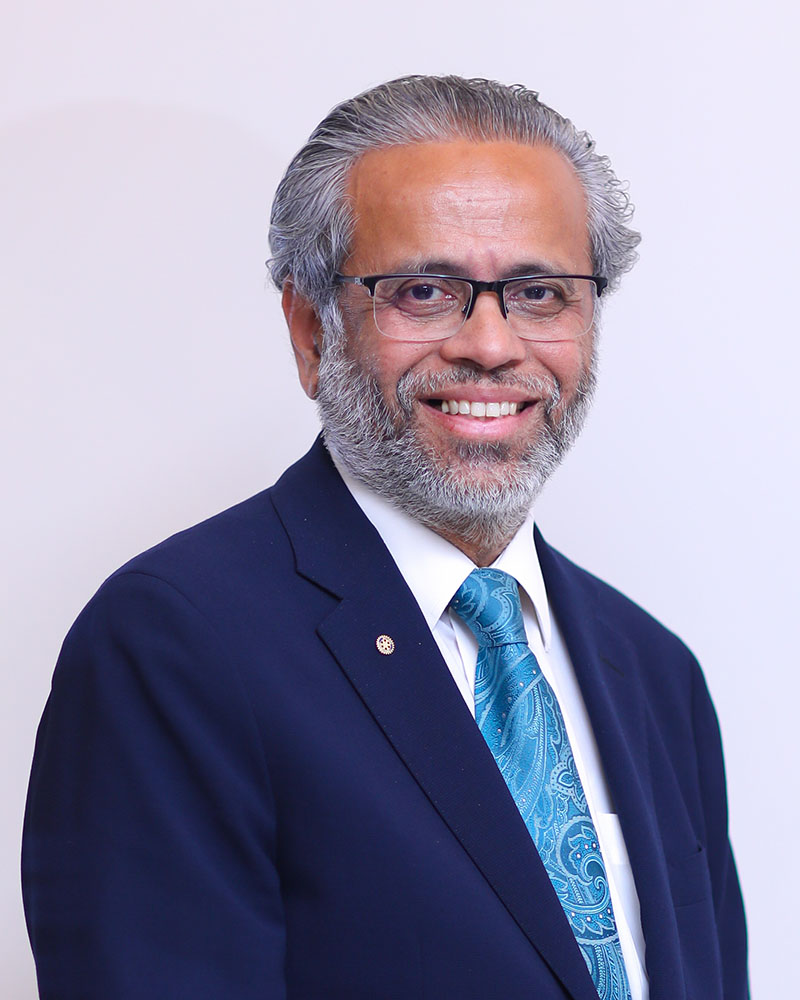
Architect, Social Entrepreneur, Humanitarian Leader
Muhammad Faiz Kidwai has spent more than forty years building — first as an architect shaping the cities of Pakistan, then as a social entrepreneur pioneering the country's first land digitization systems, and for forty-five years as a humanitarian leading some of Rotary International's most consequential initiatives. He leads a multi-sector conglomerate spanning architecture, real estate, hospitality, technology, and agriculture, serving clients across the MENAP region. A graduate of NED University of Engineering and Technology (1983) and a Harvard Aga Khan Program research fellow in Mostar, Bosnia-Herzegovina, he has carried the discipline of design into four decades of public service.
"My association with Dawood College of Engineering and Technology has tremendously contributed towards my personal development as a true Pakistani."
A Career Built Before Rotary International
Before he led Rotary International, Faiz was already redrawing the map of Pakistan — from the historic streets of Karachi to the coastline of Balochistan. His career reflects more than 150 projects and a pioneering role in the country's PropTech industry.
Public Service Foundations
- Documented 44 historic buildings of Karachi, including a tourist map and city heritage publication
- Led rehabilitation of Sindh Madressah-ul-Islam for its centennial
- Conceptualized the Mazar of Shaheed Zulfikar Ali Bhutto, Garhi Khuda Bakhsh
- Designed Pakistan's first dedicated facility for physically handicapped adults
Gwadar & the PropTech Pioneer
- Sangar Housing Gwadar — a 2,900-acre master plan and Pakistan's first land digitization system (1996)
- Represented Government of Balochistan on the Gwadar Smart Port City Master Plan under CPEC
- Modernized the Gaddani Shipbreaking Yard & Allied Industries Master Plan
- Digitized land revenue records across seven Balochistan districts
- Balochistan Land Revenue Information digitization and management services. (3 Divisions)
- Balochistan Port Authority, Asset management digitization and information management services
Reviving Karachi
- Revival of Old Town Saddar, preserving heritage while creating new public life
- Restoration of Jahangir Park and its landmark Ampi Theatre
- Long-serving member, DG Parks Advisory Committee — greening Karachi's public spaces
Regional & Rural Development
- Founded the Rotary Pakistan Smart Villages Program across flood-affected Sindh
- Authored a strategic tourism plan for the Galiyat, KPK
- Feasibility studies for a Bhurban–Pir Chinasi chairlift, AJK
- Reintroduced rammed-earth construction for wellness tourism in Gilgit-Baltistan
Thirty-Eight Years Inside Rotary's Leadership
Faiz's association with Rotary began in 1980 through Rotaract, the youth program of Rotary International. In 1987 he joined the Rotary Club of Karachi East, formally beginning a humanitarian career that has since reached the organization's most senior governing bodies.
Director, Rotary International
The first individual from Pakistan ever elected to the Board of Directors of Rotary International — the world's preeminent humanitarian service organization, with 1.4 million members in nearly 200 countries.
First Pakistani DirectorView the Full Service Record — 30+ Leadership Roles+
Forty-Five Years, Measured in Lives
Across polio eradication, peacebuilding, disaster relief, and rural development, Faiz's initiatives have mobilized more than $100 million in resources and reached communities across Pakistan, India, Bangladesh, Indonesia, and Turkey.
Polio Eradication
Transformed a one-million-population zone of Karachi into a polio-free area; held Pakistan's first Ulema Convention for Polio Eradication, drawing 200+ religious leaders.
Peace & Reconciliation
Founded the Pakistan-India Inter Country Committee; supported 100+ joint humanitarian projects and 4,500+ pediatric heart surgeries through Indo-Pak collaboration.
Disaster Relief
Facilitated distribution of ShelterBoxes valued above $25 million; rebuilt schools, shelters, and utilities after the Turbat floods, the 2005 earthquake, and the 2012 floods.
Smart Villages
Founded the Rotary Pakistan Smart Villages Program — NetZero homes, solar power, and women-led ownership — with 200 villages targeted by 2030.
Literacy & Education
Founded the Rotary Pakistan Literacy Mission; collected 900,000 books for 2,500+ libraries and helped establish Gwadar's first girls' college.
Youth Empowerment
Mentored more than 10,000 young Pakistanis through RYLA and exchange programs connecting Pakistan with India, Bangladesh, and Indonesia.
Health & Hygiene
Enabled congenital heart surgeries worth over $7 million, a pediatric cardiac research center at NICVD, and 500+ pacemaker implants through the Rotary–APCNA Bank.
Water & Sanitation
Delivered rainwater harvesting tanks across the Thar Desert and solar desalination providing 25 million glasses of drinking water annually.
Inclusion & Determination
Designed Pakistan's first dedicated center for physically handicapped adults; remains active with the Pakistan Independent Living Center.
A Lifetime of Distinguished Service
Lifetime Achievement Award
Conferred by Dawood University of Engineering and Technology — the first such award in the university's history — in recognition of Faiz's philanthropy and humanitarian service.
Representing Pakistan, Advancing Rotary
"The worth of our life will not be determined by how much we leave behind — but by the qualitative change we bring to the lives of our fellow human beings."— Muhammad Faiz Kidwai